 MarketClaims
The MarketClaims Brief · Published research
Will the 10-year Treasury yield dip below 3.9% before 2027?
30 dated claims from 5 publishers are collected below, each with its source. 0 point toward YES and 8 against it; the rest are context. The research behind this brief is dated 1 November 2026. No direction or probability is published here: the claims and their sources are the brief.
Economy brief. Evidence collected and research dated , published .
This is an older research snapshot. It may miss subsequent developments.
What the evidence does
- 0
- Toward yes
- 8
- Against yes
- 22
- Context
How this market settles
What could still go wrong
- The phrase 'lower than the listed value' uses strict inequality (< 3.9%), but it is not explicitly stated whether exactly 3.9% would resolve YES or NO — based on wording 'lower than' it would be NO at exactly 3.9%.
- The resolution window starts November 11, 2025, but the market end date is December 31, 2026, creating a gap where the market could resolve early (as soon as yield dips below 3.9%) or at end of period.
- No explicit timezone is specified for the daily yield observation cutoff, though 'ET' is referenced for the 14-day grace period.
- The URL provided in the description points to 2025 data only; for 2026 dates, a different URL would be needed, potentially creating a sourcing ambiguity for 2026 resolution data.
Evidence you can inspect These labels describe how a claim relates to the question. They are not recommendations or independent votes.
Evidence supporting YES 0 claims
No claims in this category. Absence here is a coverage limit, not a finding.
Evidence challenging YES 8 claims
 Against yes
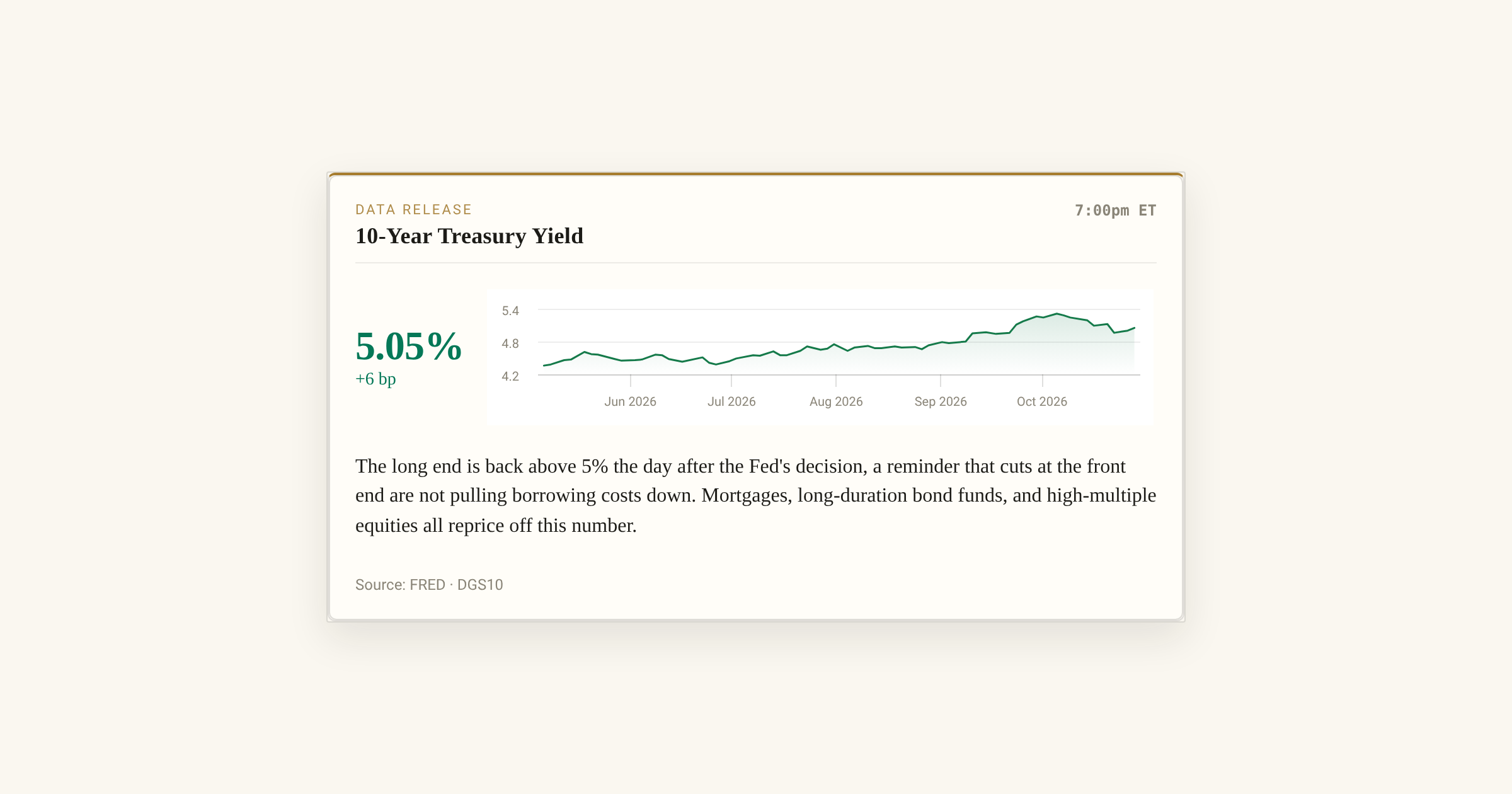
The 10-year Treasury yield has increased from near 4.36% to above 5%
24/7 Wall St. published Source publication24/7 Wall St.published Against yesA Federal Reserve cut that leaves the 10-year Treasury yield at 5.05% offers little practical relief to homebuyers or those refinancing
24/7 Wall St. published Source publication24/7 Wall St.published Against yesThe 10-year Treasury yield rose 6 basis points to 5.05% the day after the Federal Reserve's decision
24/7 Wall St. published Source publication24/7 Wall St.published Source publicationThe Jolt Journalpublished Source publicationThe Jolt Journalpublished Against yesThe 10-year Treasury yield closed at 5.05% on October 28, which was the first time it was above 5% since October 21, according to Treasury data
The Jolt Journal published Source publicationInstaForexpublished Against yesThe yield on the US 10-year Treasury note fell toward 4.9% on Friday, reaching its lowest level in seven weeks
InstaForex published Source publicationcj.sina.com.cnpublished Against yesOn October 26, 2026, the US Treasury yield curve showed divergence: the 2-year yield rose to 4.705%, the 3-year to 4.774%, and the 5-year to 4.821%, while the 10-year yield fell to 4.982% and the 30-year to 5.301%
cj.sina.com.cn published
Context 22 claims
Source publicationInstaForexpublished ContextThe US PCE price index rose 0.5% in September, marking the largest monthly increase since March
InstaForex published Source publicationInstaForexpublished ContextFutures markets indicate approximately a 75% probability of a December rate hike, according to the CME FedWatch Tool
InstaForex published  Context
The economy grew at a 3.4% annual rate in the third quarter, according to the Bureau of Economic Analysis
The Jolt Journal published Source publicationThe Jolt Journalpublished Source publicationThe Jolt Journalpublished ContextThe Federal Reserve held its target interest rate range at 3.75% to 4% in a 10-2 vote
The Jolt Journal published Source publicationThe Jolt Journalpublished ContextFederal Reserve Governor Lisa Cook and Cleveland Fed President Beth Hammack voted for a quarter-point rate hike
The Jolt Journal published Source publicationThe Jolt Journalpublished ContextThe gap between the 2-year and 10-year Treasury yields widened to 38 basis points from 29 basis points
The Jolt Journal published Source publicationInstaForexpublished ContextA broad selloff in global tech and AI-related stocks drove investors into government bonds
InstaForex published Source publicationETF Databasepublished ContextFollowing the September FOMC meeting, 10- and 30-year Treasury yields climbed roughly 25 to 30 basis points by October 7, but have since reversed
ETF Database published Source publicationETF Databasepublished ContextLonger-term Treasury yields have fully retraced their post-FOMC rise, but broader financial conditions remain tight
ETF Database published Source publication24/7 Wall St.published ContextAs yields rise, the prices of existing bonds fall, with longer-maturity holdings experiencing the largest losses
24/7 Wall St. published Source publication24/7 Wall St.published ContextMortgage rates are priced off long-term Treasuries, not the federal funds rate
24/7 Wall St. published Source publication24/7 Wall St.published ContextLong-term borrowing costs are moving independently of the Federal Reserve's actions at the short end of the curve
24/7 Wall St. published Source publicationThe Jolt Journalpublished ContextJeffrey Gundlach argued that the Federal Reserve should be raising rates and expects headline inflation to approach 4%
The Jolt Journal published Source publicationInstaForexpublished ContextThe rise in the PCE price index is bolstering expectations that the Federal Reserve may raise interest rates again later this year
InstaForex published Source publication24/7 Wall St.published ContextWhen the risk-free rate is above 5%, the discount rate applied to future earnings increases, reducing the present value of growth companies
24/7 Wall St. published Source publicationInstaForexpublished ContextDisappointing earnings from major technology firms including Alphabet, Amazon, and Intel deepened concerns about the sustainability of the AI-driven rally
InstaForex published Source publicationInstaForexpublished ContextThe US economy grew at an annualized pace of 3.4% in Q3, exceeding expectations
InstaForex published Source publicationInstaForexpublished ContextSolid consumer spending and continued AI-focused investment supported the Q3 US economic growth
InstaForex published 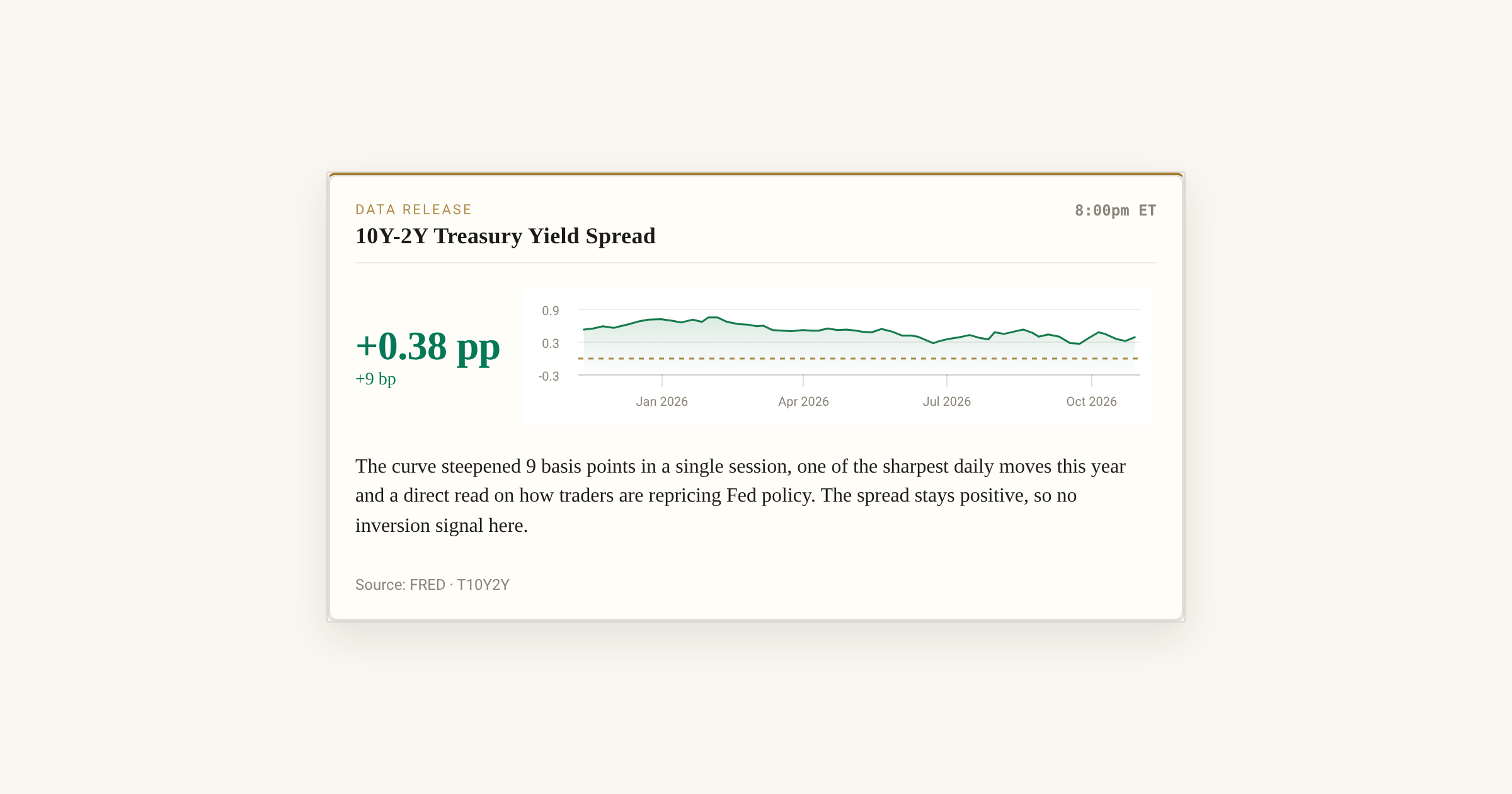 Context
A negative reading, where 2-year yields exceed 10-year yields, is the classic inversion signal that has historically preceded recessions
24/7 Wall St. published Source publicationcj.sina.com.cnpublished ContextA report from CNstock in August 2026 quoted a fund manager stating that the yields on long-term corporate bonds issued by AI tech giants can reach 6%-7%, diverting some long-term funds and creating a crowding-out effect on US long-term Treasury bonds
cj.sina.com.cn published Source publicationETF Databasepublished ContextSince the September FOMC meeting, investment grade and high yield credit spreads have widened by 12 and 67 basis points, respectively
ETF Database published
Who reported it 5 publishers, each setting its own name
- 24/7 Wall St. 9
- InstaForex 8
- The Jolt Journal 8
- ETF Database 3
- cj.sina.com.cn 2
What this brief cannot settle
This brief was assembled automatically from a research report that met a published quality bar. No individual review. It rests on 30 claims from 5 publishers; anything not reported in those sources is not represented here. The report recorded 4 resolution risks, listed with this brief.
Since the previous brief
Publication history (2 recorded revisions)
- Published · research dated
- Published · research dated
Compared with research dated
This revision replaces research dated 31 October 2026 with research dated 1 November 2026. 0 of 6 cited sources are new; 6 are carried over.
More published research
Economy ·
MPS x Intesa Sanpaolo merger/acquisition announced in 2026?
30 dated claims from 5 publishers are collected below, each with its source. 15 point toward YES and 0 against it; the rest are context. The research...
Economy ·
Will the official close price for the Nikkei 225 on the final trading day of December 2026 be between 70,000 and 75,000?
30 dated claims from 14 publishers are collected below, each with its source. 0 point toward YES and 25 against it; the rest are context. The research...
Economy ·
Anthropic vs OpenAI - higher valuation on December 31?
30 dated claims from 10 publishers are collected below, each with its source. 3 point toward YES and 0 against it; the rest are context. The research...